A streaming service can recommend a show by learning from patterns in what viewers watch, one familiar use of machine learning. The same technology can help us sort information, spot trends, and make predictions. It can also generate new text, images, audio, or video.
Machine learning is part of artificial intelligence, but it is not a synonym for all AI. Its value depends on the examples it learns from, the tests we use, and the choices people make around its output. Good data and human judgment matter as much as a model’s prediction.
Understanding the basics helps us ask better questions when a tool makes a claim or suggests an action. We can learn what the system uses, where it may fail, and when a person should take a closer look.
A prediction is a useful input to a decision, not a guarantee that the decision is right.
Key Takeaways
- Machine learning uses examples to find patterns and make predictions or create content.
- It is one part of artificial intelligence, not the whole field.
- Different learning approaches need different data and feedback.
- Testing on new examples shows whether a model can generalize.
- Human review matters when a prediction could affect someone’s health, money, or rights.
- Beginners can start with a structured course and one small project.
What Is Machine Learning and How Does It Work?
Machine learning lets software learn patterns from data instead of relying only on rules written in advance. Rather than listing every rule, we train a model to turn examples into predictions or other outputs.
Machine learning is a subset of artificial intelligence, and not every AI system learns from data. Rules-based software follows instructions written by people, such as adding sales tax at a fixed rate.
Machine learning learns patterns from data, but artificial intelligence also includes systems built from rules.
How artificial intelligence and machine learning differ
Artificial intelligence, or AI, is the broad field of building systems that perform tasks linked with human intelligence. Machine learning is one way to build those systems.
A learning algorithm adjusts a model using examples. A rules-based system can still be AI, even when it has no training data and does not change through experience.
ChatGPT is an AI application powered by machine learning. It works through text-based chat, so its abilities do not make it a general human-like intelligence.
How AI capability labels differ from learning methods
AI labels describe different things, so seven familiar terms do not mean seven existing kinds of AI. Capability labels group AI as Narrow AI, General AI, or Super AI.
Only Narrow AI exists today; General AI and Super AI remain theoretical. A Syracuse University overview of AI categories explains this capability split.
Functionality labels instead describe how a system handles information: Reactive Machine, Limited Memory, Theory of Mind, and Self-Aware AI. Theory of Mind and Self-Aware AI remain theoretical categories.
IBM Deep Blue is a Reactive Machine example because it has no memory of past games. Limited Memory AI can use past and present data, but cannot keep a long-term library of experiences.
ChatGPT is Narrow AI and uses Limited Memory capabilities. Learning methods, such as supervised learning, describe how a model learns, not what kind of AI capability it has.
Narrow AI describes what current AI can do, while labels such as supervised learning describe how a model learns.
Which Learning Approach Fits Each Task?
The right learning approach depends on whether we have known answers, unlabeled examples, or feedback from actions. The task sets the method, because each approach needs a different kind of signal.
Supervised learning needs labeled data, while reinforcement learning needs feedback about actions. Unsupervised learning finds structure without known answers, and generative AI creates new outputs from learned patterns.
Supervised learning predicts labeled outcomes
Supervised learning uses labeled examples, where each input comes with a known answer. A spam filter, for example, learns from messages marked “spam” or “not spam.”
Classification predicts a category, such as spam or not spam. Regression predicts a number, such as the amount of rainfall expected from weather data.
Google’s rainfall example uses weather data to predict an amount of rain. The known measurements and rainfall amounts give the algorithm examples to learn from.
Unsupervised learning finds patterns without answer labels
Unsupervised learning works with unlabeled data. It groups similar examples or finds patterns without being told what each group means.
A shop might use it to group customers by buying habits. The groups can reveal useful differences, but people must interpret what those patterns mean.
Reinforcement learning improves through rewards
Reinforcement learning trains an agent to choose actions and learn from rewards or penalties. The agent tries an action, sees its result, and changes its next choice.
A game agent might earn a reward for reaching a goal and lose points for a poor move. A robot could use feedback to improve how it moves an object.
This trial-and-error approach differs from learning from a fixed set of right answers. The reward guides the agent, but does not spell out every action.
Generative AI creates new outputs from learned patterns
Generative AI learns patterns in existing data, then creates new text, images, audio, or video. It does not simply copy one example as its output.
Further supervised learning or reinforcement learning can shape a generative model’s responses. That added training can guide style or behavior, while the model still generates new outputs.
Semi-supervised learning combines labeled data with unlabeled data. It can help when collecting known answers takes more time or effort than gathering examples.
| Approach | Data or feedback | Typical output | Concrete example |
|---|---|---|---|
| Supervised learning | Labeled examples | Number or category | Spam classification |
| Unsupervised learning | Unlabeled data | Groups or patterns | Customer clusters |
| Reinforcement learning | Rewards or penalties | Action choice | Game agent move |
| Generative AI | Examples of existing content | New content | Generated text |
When labels are scarce but some known answers exist, semi-supervised learning can combine labeled and unlabeled examples.
How Does a Model Learn From Data?
A house-price model can learn how square footage, bedrooms, and house age relate to sale prices. Each feature adds a clue, while the model combines those clues into a numeric prediction.
A model’s training performance does not show how well it will perform on new examples. Generalization is a model’s ability to perform accurately on new examples it did not see during training.
From examples to a trained model
We first prepare training data and represent each example with useful inputs, called features. A house might have 1,900 square feet, four bedrooms, and an age of 30 years.
The model uses those features to produce an output, such as a predicted sale price. This example shows the kind of relationship it can learn, not a real price for that house.
A supervised model has three main parts: a decision process, an error function, and an update process. The decision process makes a prediction, while the error function measures its difference from the known answer.
An optimization process then adjusts the model’s parameters to reduce that error. Machine learning algorithms differ in how they make these updates and what patterns they can learn.
Testing whether a model generalizes
We keep some examples out of training and use them to evaluate the model. These held-out examples let us test predictions on data the model did not learn from.
If the model performs well only on its training data, it may have learned details that do not hold elsewhere. Evaluation helps us spot that gap before relying on predictions.
After testing, we can also monitor predictions in use. Data can change over time, so a model that once worked well may need a new review.
- Prepare examples and choose useful features.
- Train the model by comparing outputs with known answers.
- Evaluate performance on unseen examples.
- Monitor predictions after the model enters use.
A model that performs well on its training examples still needs evaluation on data it has not seen.
Where Do We Use These Models in Daily Life?
A recommendation engine turns a history of viewing choices into suggestions for what to watch next. That same pattern appears in many daily tasks, from search results to fraud alerts.
Models can sort information or flag patterns, while people decide what action to take. Netflix recommendations, for example, use viewing patterns to suggest titles a viewer may like.

Recommendations, search, and fraud detection
Recommendation systems use past choices to rank items, while search systems can sort results for a query. Fraud detection models look for transaction patterns that differ from expected activity.
A flag does not prove that a transaction is fraud. It gives a person or another system a reason to review the activity more closely.
Businesses also use chatbots to answer common questions and route requests. Our guide to AI automation software for business workflows covers other uses, such as sorting customer messages and extracting invoice details.
Health, transportation, and scientific research
Medical-image models can mark areas in CT images for a clinician to review. Self-driving vehicles use machine learning as part of systems that sense nearby objects and help guide movement.
In health care, a model’s output is one piece of information, not a diagnosis on its own. A qualified clinician can consider the image, the patient’s history, and other evidence.
Weather forecasting uses current and historical weather data to predict conditions, including rainfall. These predictions can help people plan, though they remain estimates rather than guarantees.
Scientific facilities also create large volumes of data. The US Department of Energy reports that machine-learning analysis has found patterns hundreds to thousands of times faster than traditional data-analysis techniques.
| Application | Example input | Useful output |
|---|---|---|
| Recommendations | Viewing history | Suggested titles |
| Fraud detection | Transaction patterns | Suspicious-activity flag |
| Chatbots | Conversation text | Response |
| Medical imaging | CT images | Marker for clinician review |
| Weather forecasting | Current and past weather data | Rainfall prediction |
In high-stakes settings such as medical imaging, a model’s result is best treated as decision support for a qualified person.
What Can Go Wrong With a Learning Model?
A model can make a confident prediction for the wrong reason. That hidden shortcut may come from biased data, a weak signal, or an accidental link in the examples.
Predictions can be unfair or unreliable when training data fails to represent the people or cases we care about. Sensitive data also creates privacy and security risks if access is not controlled.
Bias, privacy, and poor-quality data
If a training set leaves out some groups, a model may work less well for them. It can also repeat unfair patterns already present in past decisions.
An X-ray model might appear to detect illness while actually relying on the type of imaging machine. It has learned a shortcut instead of reading the medical image as intended.
Small changes to image metadata can also lead a model to misidentify a dog as an ostrich. The image may look nearly the same to a person, but the model can respond to a changed signal.
These failures show why we must test inputs, not just headline accuracy. Business automation systems also need checks on data access, permissions, and audit controls.
Why predictions can be hard to explain
Deep learning uses neural networks with many layers to find patterns in data. Those networks can need substantial data and computing power, and their inner steps may be hard to interpret.
Explanations can also be less reliable for some groups. A study on fairness in machine-learning explanations found subgroup gaps in how well explanations matched model behavior.
When a model uses personal records, images, or health details, weak security can expose private information. We should limit data access and use only information needed for the task.
- Check whether the data represents the people and cases the model will face.
- Test for errors across relevant groups.
- Review explanations or the input signals that matter most.
- Keep human review for decisions with serious effects.
Before relying on a consequential prediction, check what evidence the model used and who reviews the result.
Which Programming Languages Are Used in AI?
Python is the practical starting language for most machine-learning experiments, while C++ is valuable when inference must be especially fast. Start with Python unless a project’s speed or control needs point elsewhere.
Python suits experimentation and training; C++ often suits low-latency production systems. Teams can also use both languages, or add Rust for performance-sensitive parts.
Python supports experimentation and model training
Python is widely used in data science, machine learning training, deep-learning research, natural language processing, and computer vision. It also supports fine-tuning large language models.
Common tools include TensorFlow, PyTorch, scikit-learn, Keras, and Hugging Face Transformers. GitHub’s 2024 Octoverse report identifies Python as its most-used language overall.
Python makes it easy to test ideas, work with data, and connect libraries. CPython’s Global Interpreter Lock limits true multithreaded parallel work within one process, though multiprocessing and asynchronous input and output can help.
C++ and Rust support performance-sensitive components
C++ is common in real-time inference, autonomous vehicles, robotics control loops, low-latency trading models, and game AI. ONNX Runtime and TensorRT are among its tools.
Python’s interpreted execution can be slow for some performance-critical inference tasks. Production systems may move those components to C++ or Rust while keeping Python for model work.
One workload-specific comparison reported 4-12× lower latency after moving CPython inference loops to TensorRT and LibTorch. That result does not promise the same speed gain on different hardware or workloads.
CPython’s Global Interpreter Lock limits true parallel processing inside one process. Moving to a compiled component can help when measurement shows that inference speed is a real bottleneck.
| Workflow choice | Common role | Named tools or components |
|---|---|---|
| Python prototyping | Experiments and training | PyTorch, scikit-learn |
| C++ production inference | Fast inference and control | ONNX Runtime, TensorRT |
| Python plus C++ or Rust | Flexible production stack | Python, C++, Rust |
Python is the common starting choice for most learners. C++ is a stronger choice when tight inference latency or real-time control is the main constraint.
Choose the language for the bottleneck, and do not rewrite a working Python system in C++ without a measured performance need.
How Can Beginners Learn the Field?
A beginner can build a useful foundation by pairing a structured course with one small, evaluated project. Regular study can build core knowledge in three months, but it does not guarantee job-ready mastery.
Start with data preparation and supervised learning, then add more advanced topics as your skills grow. A project gives us a way to test what we learn.
Start with a structured course
Google’s Machine Learning Crash Course covers regression, classification metrics, data preparation, neural networks, embeddings, and large language models. It also includes production systems, automated machine learning, and fairness auditing.
The refreshed course marks LLM tokens, Transformers, and fairness auditing as new topics. We can first learn basic terms and prepare data, then move into neural networks and production systems.
Choose books for your current level
The Hundred-Page Machine Learning Book by Andriy Burkov and Machine Learning for Absolute Beginners by Oliver Theobald suit first steps. Machine Learning for Humans by Vishal Maini and Samer Sabri is a free five-chapter e-book.
For practical Python work, try Hands-On Machine Learning with Scikit-Learn, Keras, and TensorFlow by Aurélien Géron. Python Machine Learning by Sebastian Raschka and Vahid Mirjalili suits readers who already know basic Python.
Machine Learning Yearning by Andrew Ng focuses on project strategy. An Introduction to Statistical Learning offers tutorials using R, while Machine Learning for Hackers by Drew Conway and John Myles White teaches through case studies.
For math and neural-network depth, consider Pattern Recognition and Machine Learning by Christopher M. Bishop or Deep Learning by Ian Goodfellow, Yoshua Bengio, and Aaron Courville.
Reinforcement Learning: An Introduction by Richard S. Sutton and Andrew G. Barto covers reinforcement learning. Natural Language Processing with PyTorch by Delip Rao and Brian McMahan offers practical NLP work.
Find papers and journals for deeper study
The Journal of Machine Learning Research publishes research papers, and NeurIPS and ICML are major research venues. A research journal impact factor changes by year, so check the current Journal Citation Reports.
Do not treat an impact factor as a stable quality score for every paper. Read the paper’s question, method, and results, then compare its claims with your own project.
- Learn core vocabulary and basic ideas.
- Work through a structured course in order.
- Build one small project and evaluate it on unseen examples.
- Read a paper related to the project you built.
A paper is easiest to learn from when we can connect its method to a project we already understand.
What Do AI Engineer Salaries Look Like?
The US median annual salary for AI engineers is $145,080, with projected job growth of 26 percent from 2023 to 2033. That outlook compares with 4 percent growth across all occupations.
Location, experience, employer, and role scope all affect individual pay. Jobs requiring AI skills pay nearly 25 percent higher wages than jobs that do not require those skills.
The national median is a useful benchmark, not a promise for every location or role.
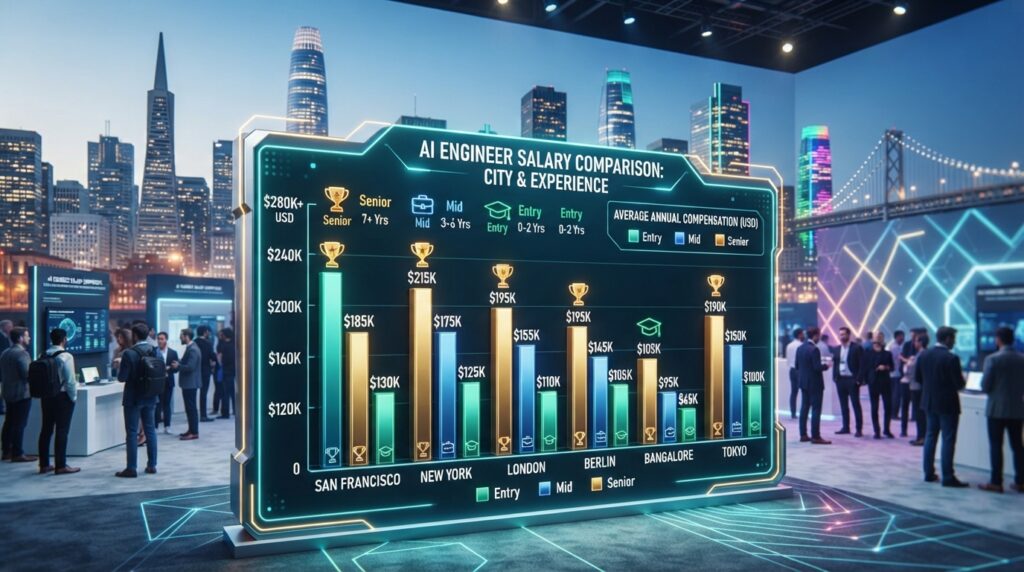
City estimates show how pay can differ across the country. San Jose and Boston appear at the top of the five-city comparison below.
| City | Annual base salary |
|---|---|
| San Jose, CA | $206,706 |
| Boston, MA | $189,318 |
| New York, NY | $189,274 |
| Santa Clara, CA | $186,734 |
| Nashville, TN | $158,077 |
Dallas, TX, has an annual estimate of $151,692, while Austin, TX, is at $138,701. Seattle, WA, has an annual estimate of $136,347.
Experience also changes salary comparisons. These estimates rise across the listed career stages, but they do not describe every employer or job.
| Experience | Annual salary |
|---|---|
| 0-1 years | $103,015 |
| 1-3 years | $121,513 |
| 4-6 years | $138,185 |
| 7-9 years | $155,008 |
| 10-14 years | $172,361 |
For 15 or more years of experience, the annual estimate is $185,709. A research role, product role, or engineering role may carry different duties and pay.
Compare salary figures by location and experience rather than treating one national median as an offer for every role.
Conclusion
A machine-learning model is most useful when it helps us answer a well-defined question with evidence we can check. Clear goals make it easier to judge whether the output helps.
We can start with one small problem, review the data, and test predictions on examples the model has not seen. When a decision matters, human judgment should remain part of the process.
Choose one small prediction task, evaluate its results on new examples, and decide whether its outputs genuinely improve the decision.