A compromised account, exposed device, or interrupted network can put business operations and sensitive data at risk at the same time. Enterprise Cybersecurity Solutions help us see these threats as business risks, not just technology problems.
Cloud services, office networks, and remote work connect people and systems across the business. A gap in one place can affect customer trust, daily work, or the ability to meet legal duties. Protection works best when it supports business resilience across every work setting.
We can identify gaps and match controls and services to the risks that matter most. The right approach considers the team, the data it handles, and the operations it must keep running. A useful security plan starts by protecting the assets and operations the organization cannot afford to lose.
Key Takeaways
- Protect business data, users, devices, and operations as connected assets.
- Match security controls to the risks that could disrupt work.
- Plan for cloud, office, and remote-work environments.
- Assign clear owners for important systems and information.
- Test response and recovery plans before an incident occurs.
What Do Enterprise Cybersecurity Solutions Include?
A complete enterprise security program combines access, endpoint, network, cloud, and data controls with monitoring and response. Enterprise security includes cybersecurity, but also covers policies, people, and business-wide governance.
Cybersecurity protects digital assets; enterprise security also accounts for people, business processes, data in transit, and legal duties. NIST Cybersecurity Framework 2.0 helps organize these outcomes across an organization.
Enterprise security includes cybersecurity, plus the policies, people, and governance that shape how the whole business manages risk.
Access, endpoint, and network controls
Identity access management (IAM) sets who can use each account, system, and application. Multifactor authentication (MFA) asks users to prove their identity in more than one way.
Least privilege gives each person only the access needed for their work. Endpoint protection helps protect laptops, phones, and servers from harmful software or unsafe activity.
Firewalls filter network traffic, while network segmentation separates systems into smaller zones. These controls can limit an attacker’s reach if one account or device is compromised.
Data protection across cloud and applications
Data security controls help keep sensitive information private and available to approved users. Encryption makes data harder to read if someone intercepts it or takes a device.
Data loss prevention tools can flag or block the unsafe sharing of sensitive files. Cloud security applies access and monitoring rules across public cloud services, private systems, and hybrid environments.
Application security checks software for weaknesses during development and after launch. Teams can reduce exposure by fixing flaws before attackers use them.
Monitoring, response, and governance
A security information and event management system (SIEM) collects and links alerts from many systems. A security orchestration, automation, and response platform (SOAR) can run repeatable response steps.
Threat intelligence adds information about current attacker methods and signs of compromise. A security operations center (SOC) monitors activity and helps teams review alerts and respond.
Security solutions work best when policies define who owns each control and how teams use it. The table shows how common capabilities support distinct parts of the program.
| Capability | What it protects | Core control | Operational role |
|---|---|---|---|
| IAM | User accounts and applications | MFA and least privilege | Manage access and account changes |
| Endpoint security | Laptops, phones, and servers | Endpoint protection | Block or flag unsafe activity |
| Network and cloud security | Network traffic and cloud systems | Firewalls and segmentation | Limit connections and system access |
| Data protection | Sensitive files and records | Encryption and loss prevention | Control storage, use, and sharing |
Map each control to a specific asset, owner, and business risk before choosing a tool.
How Do Layered Controls Reduce Risk?
Multiple control layers reduce risk by making it harder for an attacker to gain access, move across systems, and remain undetected. Defense in depth is a security approach that uses multiple, complementary controls so a failure in one layer does not leave the organization unprotected.
Zero trust checks access continuously, rather than trusting a user or device once and forever. Segmentation limits movement between systems, while vulnerability management helps teams find and fix weak points.
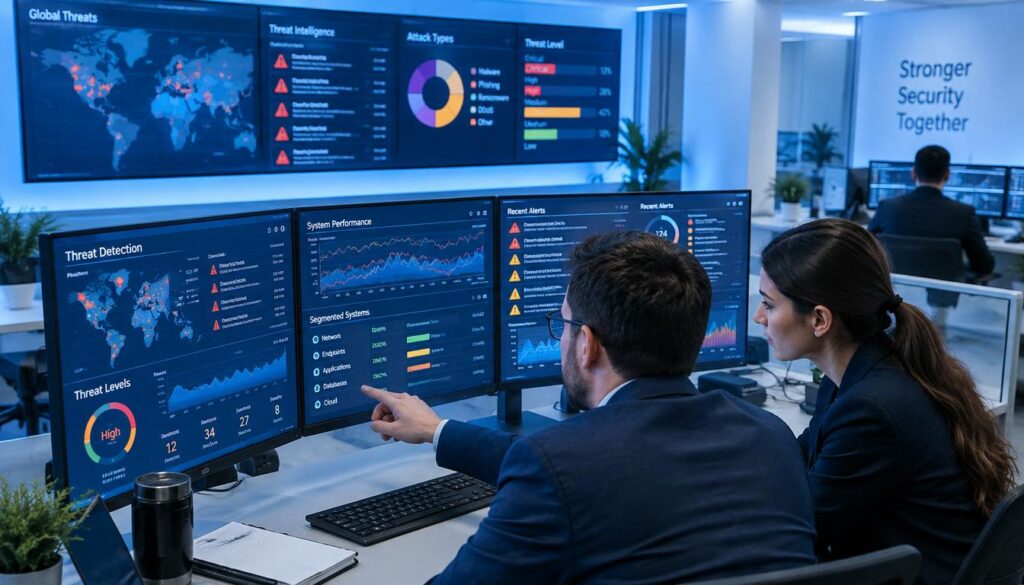
Prevent unauthorized access and limit exposure
A practical cyber security tools list includes IAM, MFA, endpoint protection, EDR or XDR, SIEM, SOAR, next-generation firewalls, network detection and response, data loss prevention, and cloud security.
Next-generation firewalls can inspect network traffic deeply, and sandboxing can hold suspicious files for safe review. These controls can help protect devices and contain threats before they spread.
Access management and regular vulnerability fixes reduce the chances that a weak account or unpatched system becomes an easy entry point.
Detect, investigate, and respond to threats
Network detection tools look for unusual activity between systems. SIEM aggregates and correlates security events, while XDR detects and responds across endpoints, networks, and cloud environments.
SOAR automates repeatable response workflows, and threat intelligence helps explain what an alert may signal. Together, these tools support threat detection and detection response without replacing human judgment.
Splunk sells software that organizations deploy and run themselves, not a managed service. Splunk Enterprise Security uses a triaging agent to assess, rank, and explain alerts, and its malware analysis reviews scripts line by line.
Its automation can handle routine, low-complexity SOC tasks, with options ranging from automated actions to steps that need human approval. Teams can also use natural-language commands to build playbooks and detection rules. Its agentic AI features offer one example, not an endorsement.
Before choosing a tool, use these five checks to judge whether it fits your team and systems:
- Which data sources does the tool cover?
- Which systems and applications can it integrate with?
- What response actions can it take?
- Can a person approve actions before they run?
- How much work will setup and daily use require?
Test an automated containment action in a controlled environment before allowing it to affect production systems.
How Much Should We Budget for Enterprise Security?
A small business or startup can use $10,000-$100,000 a year as a planning range, then adjust for its risks and required coverage. Start with the work the budget must support, not a product price alone.
Budget size depends on company scale, data sensitivity, existing controls, coverage hours, and project scope. An industry best practice suggests setting aside 7-10% of the IT budget for cybersecurity, though actual needs differ.
Set a budget around scale and risk
Estimated annual cybersecurity budgets range from $10,000-$100,000 for small businesses and startups, $100,000-$500,000 for mid-sized companies, and $500,000 or more for enterprise organizations.
Yet 47% of U.S. businesses with fewer than 50 employees allocate no cybersecurity budget. A small business cybersecurity budget must pay for the protections and support it needs; zero allocation is not a workable plan.
Review the data the business holds, the systems it relies on, and the hours it needs monitoring. Security posture management also depends on current tools and staff capacity.
Compare products, managed services, and consultants
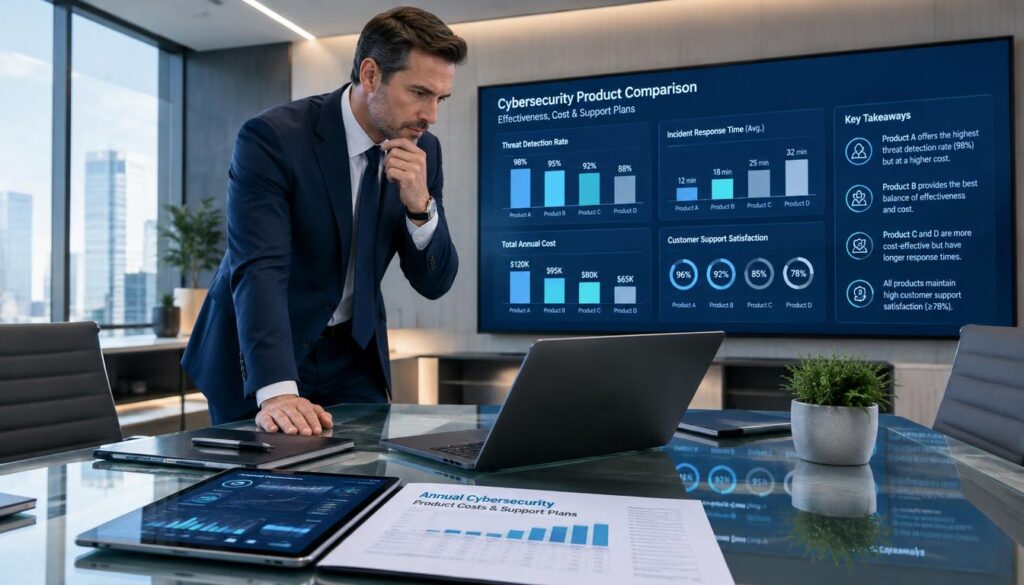
Listed product costs vary widely by provider and company size. These annual ranges are planning figures, not quotes from our organization.
| Provider | Listed annual range | Stated minimum company size |
|---|---|---|
| Palo Alto Networks | $150,000-$2 million or more | 500 employees |
| CrowdStrike | $50,000-$500,000 or more | 200 employees |
| Fortinet | $20,000-$300,000 | 50 employees |
| Sophos | $5,000-$100,000 | 10 employees |
Managed services can add monitoring or response support when an in-house team lacks coverage. Compare the service hours and response duties with the product’s license cost.
Deloitte, KPMG, PwC, and EY are the Big Four cybersecurity consulting firms. Deloitte lists engagements at $300,000-$8 million or more and $400-$650 per hour.
KPMG lists $250,000-$5 million or more per engagement and $350-$600 hourly. PwC lists $250,000-$4 million or more and $350-$650 hourly.
EY lists $200,000-$3 million or more per engagement and $350-$600 hourly. These hourly ranges assume multi-month work with five to fifteen named resources.
Accenture Security lists engagements at $500,000-$15 million or more, with rates of $300-$600 per hour. Boutique consultants may charge $150-$350 hourly.
Project fees for audits or penetration tests may run $15,000-$150,000, based on scope. Virtual CISO retainers may cost $5,000-$25,000 per month.
Palo Alto Networks’ listed range shows why employee minimums matter when comparing providers. Ask providers to separate one-time implementation, recurring services, and optional project fees in every proposal.
Which Emerging Threats Should We Prepare For?
In 2026, enterprise teams need to govern AI agents and prepare for cryptographic change while tightening identity controls. Preparation begins with ownership, clear permissions, and plans for failure.
Quantum risk calls for a planned cryptography replacement effort, not a claim that current systems are already broken. Gartner published six cybersecurity trends for 2026 on February 5, including agentic AI, postquantum cryptography, IAM, and security awareness training.
Govern AI agents and automated response
AI agents can perform tasks across applications, often with access to business data and systems. Start by listing approved agents and looking for unapproved ones created without formal approval.
Record each agent’s owner, purpose, systems, and data access. Limit permissions to the task, and remove access when the agent no longer needs it.
Write incident-response playbooks for agent failures, such as unsafe actions, unexpected access, or a service that stops working. Test who can pause an agent and how teams will review its actions.
AI can automate routine cybersecurity work, but people must still guide strategic decisions and risk management. That division matters when an automated response could affect business operations.
Prepare cryptography for quantum risk
Postquantum cryptography (PQC) is designed to protect information against future quantum attacks. Gartner expects quantum computing to make today’s asymmetric cryptography unsafe for corporate data and systems by 2030.
The recommended work is to begin replacing vulnerable cryptography in 2026. Gartner’s quantum timeline gives leaders a planning window, not a reason to assume current encryption has already failed.
Inventory where the organization uses cryptography, including applications, networks, stored data, and outside services. Prioritize systems that hold sensitive data for long periods or would be costly to replace.
Extend identity controls and security awareness
AI agents need machine identities just as people need accounts. Teams must register each agent, issue credentials in a controlled way, and set clear authorization policies.
Weak agent credentials can give an attacker a path into connected systems. Track credential changes and remove access when an agent is retired or its purpose changes.
Security awareness training helps staff spot unsafe requests and report unusual activity. It should explain how to handle suspicious messages, unexpected agent behavior, and possible data exposure.
Information security analyst employment is projected to grow 21% through 2035. That outlook reflects the continuing need for people who can assess risk and make sound decisions.
Give every AI agent an accountable owner, a documented purpose, and permissions limited to its task.
How Can We Put the Program Into Practice?
Start by identifying the data, applications, users, and systems whose loss would most disrupt the business. Rank those assets by business impact, then assign an owner and a risk rating to each.
Build protection into daily operations, then test whether teams can respond and recover. NIST Cybersecurity Framework 2.0 groups security outcomes into Govern, Identify, Protect, Detect, Respond, and Recover.
A cyber security tools for beginners approach can start with MFA and IAM, endpoint protection, and centralized logging. Add complex automation later, based on the highest-risk assets and the team’s ability to operate it.
Use this four-step sequence to turn priorities into work:
- Inventory critical assets and the data they hold.
- Assign owners and record each asset’s risks.
- Implement priority controls, such as patching, least privilege, and secure backups.
- Test response plans, then improve them based on the results.
Include security checks in application development, so teams can find flaws before launch. Keep backup copies protected from the systems they can restore.
Incident response plans should cover containment, investigation, recovery, and remediation. CISA provides incident-response planning guidance that teams can use when writing or reviewing plans.
Track control coverage, unresolved high-risk findings, response time, and recovery-test results. These measures help leaders spot gaps and see whether fixes improve resilience.
Test response and recovery with the people who own the work, not only with a written plan.
Test a recovery plan with the teams responsible for restoring the business-critical systems.
Conclusion
Strong enterprise security comes from matching protection to business risk and maintaining it as systems and threats change. Risk-based controls need accountable owners and response plans that teams have tested.
We can discuss the data, systems, and coverage needs that matter most to your organization. That conversation can help us identify an appropriate service approach without promising a fixed outcome before we understand the work.
Bring your highest-priority assets and current security gaps to a consultation so we can discuss a practical next step.